 Skip to content

Multi-Band Handheld Antenna for GPS, BDS, GLONASS & Galileo
A compact, high-gain handheld antenna that tracks all four major satellite systems across multiple frequencies. Designed for surveying handhelds, tablets (PADs) and high-precision UAV payloads, it delivers stable positioning even where the sky view is limited.
- Full-band support for GPS, BDS, GLONASS and Galileo
- High gain and wide beam for strong low-elevation reception
- Bent, lightweight design: only ≤10 g, easy to carry and use
- High out-of-band rejection against base-station interference
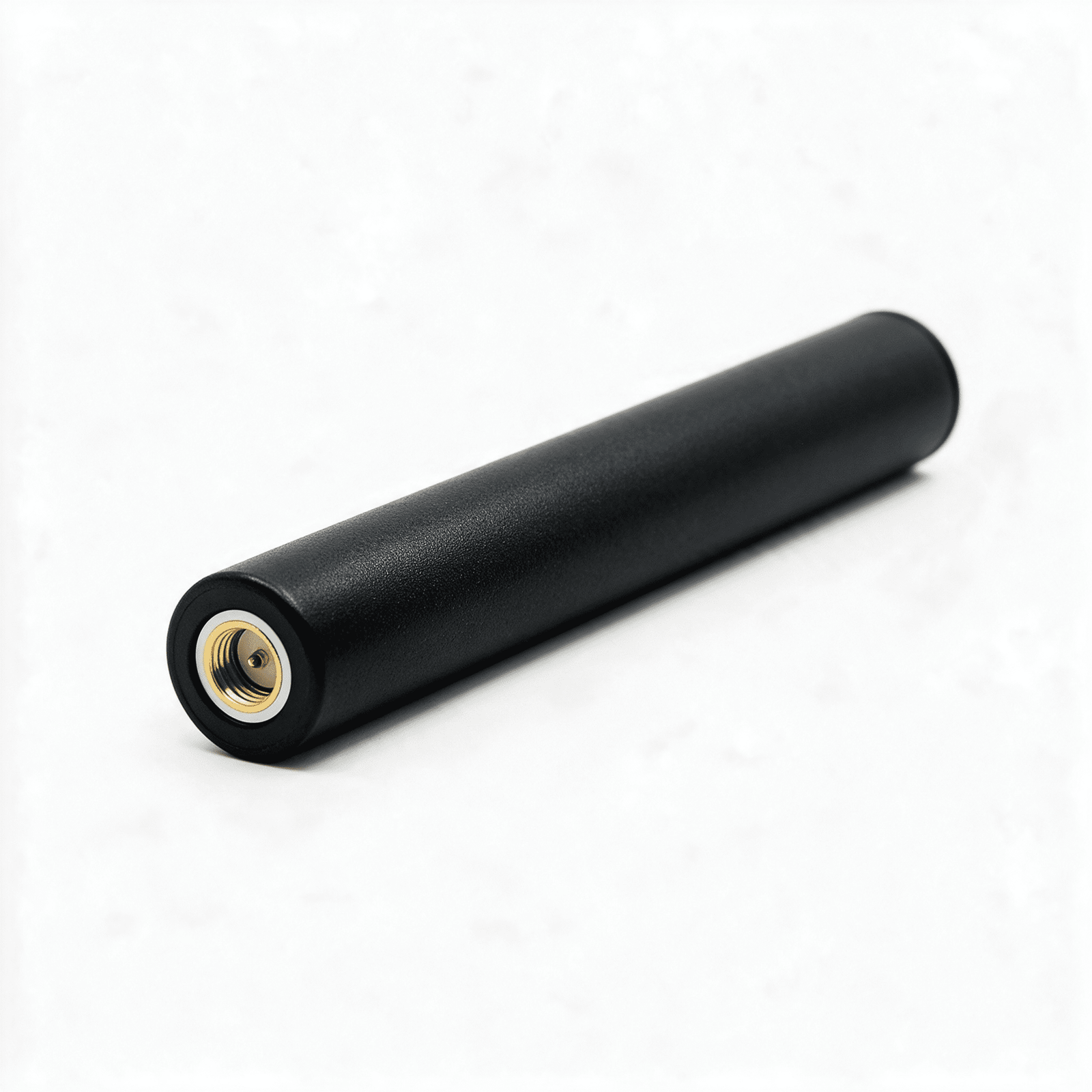

A Four-System, Multi-Frequency Handheld GNSS Antenna
This handheld antenna supports GPS, BDS, GLONASS and Galileo, covering GPS L1/L2, BDS B1/B2/B3, GLONASS G1/G2 and Galileo E1/E5b. Its wide operating bandwidth, including the globally networked BDS B3 band, helps improve system stability and positioning availability.
The bent structure keeps the antenna compact and comfortable to hold, which makes it a practical choice for surveying handheld devices, PADs and field data collectors. It is also widely used in high-precision UAVs, intelligent driving and smart agriculture.
Talk to an Antenna EngineerKey Features of Our Multi-Band Handheld Antenna
Engineered for reliable satellite reception in portable, obstructed and interference-prone environments.
High Gain, Wide Beam
High gain (up to 2.5 dBi) with a wide beam provides excellent reception of low-elevation signals, so the antenna can keep tracking satellites in environments with severe obstruction.
Wide Bandwidth, Multi-System
A wide operating bandwidth supports multi-system, multi-frequency operation, especially the globally networked B3 band, greatly improving system stability.
Compact Bent Structure
The bent design is small, lightweight and easy to carry, giving surveyors a comfortable grip and a convenient field-ready antenna.
High Out-of-Band Rejection
Strong out-of-band rejection effectively suppresses interference from communication base stations and other sources that can cause system instability.
Low-Noise Amplifier (LNA)
A 33 ± 2 dB LNA with a noise figure of ≤1.5 dB boosts weak satellite signals while keeping noise low for cleaner measurements.
Standard SMA Connection
SMA male screw-on mounting gives a secure, easy connection to common GNSS receivers, handheld controllers and UAV modules.
Why Choose a Handheld GNSS Antenna?
Surveying and mobile mapping rarely happen under open sky. Urban canyons, tree cover and low-elevation satellites all weaken the signal. A well-designed handheld antenna keeps positioning stable without adding bulk to the device you carry.
- When signals are blocked: high gain and a wide beam help recover low-elevation satellites.
- When space and weight matter: ≤10 g and Φ27.5 × 107.5 mm suit handhelds and PADs.
- When interference is present: high out-of-band rejection protects against nearby base stations.
- When you need accuracy: a phase center error of just ±3 mm supports precise measurement.

Where Our Handheld Antenna Is Used
Especially suited to surveying handheld devices and PADs, and widely used across precision positioning industries.
Surveying & Mapping
Handheld data collectors, GIS devices and field survey PADs.
High-Precision UAVs
Lightweight positioning antenna for drones and unmanned platforms.
Intelligent Driving
Reliable multi-constellation reception for vehicle positioning.
Smart Agriculture
Accurate guidance and field mapping for modern farming equipment.
Multi-Band Handheld Antenna Technical Specifications
Antenna Characteristics
| Item | Specification |
|---|---|
| Frequency range | GPS L1/L2; BDS B1/B2/B3; GLONASS G1/G2; Galileo E1/E5b |
| Impedance | 50 Ω |
| Polarization | Right-hand circular polarization (RHCP) |
| Axial ratio | ≤3 dB |
| Horizontal coverage angle | 0°–360° |
| Output VSWR | ≤1.5 |
| Maximum gain | 2.5 dBi |
| Phase center error | ±3 mm |
LNA Specifications
| Item | Specification |
|---|---|
| Gain | 33 ± 2 dB |
| Noise figure | ≤1.5 dB |
| Output VSWR | ≤2.0 |
| In-band flatness | ±1 dB |
| Operating voltage | DC 3.3–12 V |
| Operating current | ≤50 mA |
Mechanical Characteristics
| Item | Specification |
|---|---|
| Antenna dimensions | Φ27.5 × 107.5 mm |
| Antenna weight | ≤10 g |
| Connector type | SMA male |
| Mounting method | SMA screw-on mounting |
Operating Environment
| Item | Specification |
|---|---|
| Operating temperature | -25°C to +70°C |
| Storage temperature | -40°C to +70°C |
| Humidity | 95% non-condensing |

Handheld Antenna FAQs
Which satellite systems does this handheld antenna support?
It supports four GNSS constellations: GPS (L1/L2), BDS (B1/B2/B3), GLONASS (G1/G2) and Galileo (E1/E5b).
What devices is the handheld antenna suitable for?
It is especially suitable for surveying handheld devices and PADs, and is also widely used on high-precision UAVs, intelligent driving systems and smart agriculture equipment.
Can it work in places with limited sky view?
Yes. High gain and a wide beam give strong low-elevation reception, so the antenna can still receive satellite signals in environments with severe obstruction.
How does the antenna handle interference?
High out-of-band rejection effectively reduces interference from communication base stations and other sources, helping keep the system stable.
What power supply does the built-in LNA need?
The LNA operates from DC 3.3–12 V with a current draw of ≤50 mA, so it can be powered directly from most GNSS receivers.
What connector does the handheld antenna use?
It uses an SMA male connector with SMA screw-on mounting.
Looking for a Reliable Handheld Antenna?
Tell us your receiver, application and quantity. Our team will recommend the right antenna and reply with a quotation.
Request a QuoteContact Us